Accessible version — read or listen to this presentation as plain text

Visionar — AI-powered navigation glasses for people with visual impairments

Imagine navigating this space

…without being able to see it.

A crowded, cavernous train station concourse at dusk, filled with hundreds of moving commuters.

Every day millions of people navigate spaces like this effortlessly.

For over 250 million people living with severe vision loss…

…it can be overwhelming.

The problem

Vision loss is not an edge case. It is a daily navigation problem at scale.

55,000 People with severe vision loss in Denmark

People with severe vision loss in Denmark

Our first market, and the community we build with directly.

250M+ Worldwide

Worldwide

Living with moderate to severe vision impairment or blindness.

Existing solutions

Every existing tool solves part of the problem.

The white cane

Reliable, trusted, and unchanged for seventy years.

  • Strength: Always works
  • Strength: No battery, no updates
  • Strength: Universally understood

Phone apps

Powerful recognition, awkward in motion.

  • Strength: Rich object and text recognition
  • Strength: Low cost
  • Strength: Familiar hardware

Today's AI glasses

Impressive demos, built for sighted users.

  • Strength: Hands-free capture
  • Strength: Conversational answers
  • Strength: Socially discreet

None of them do all of it

Visionar

The product

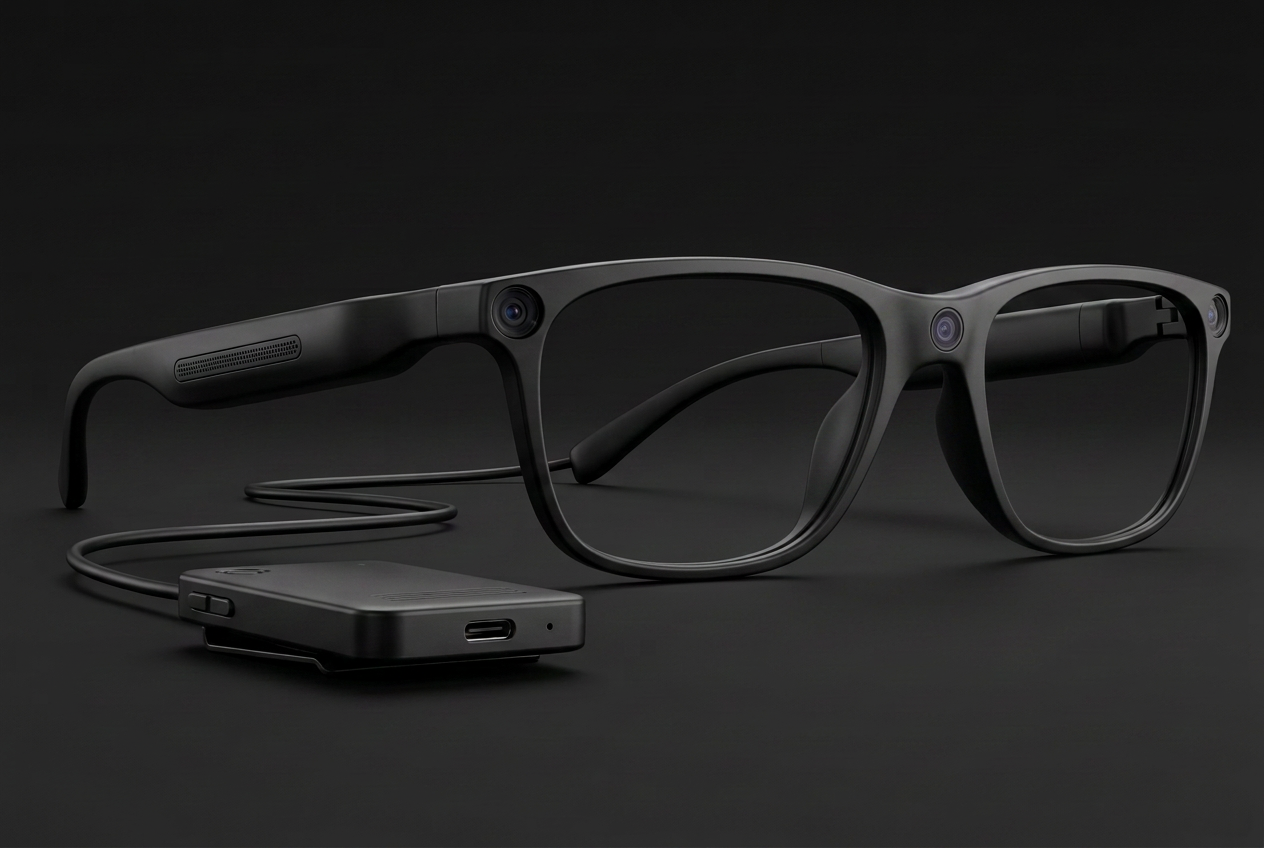
Two parts. A head unit that senses, and a pack that thinks.

A lightweight wearable in two parts, developed so that depth sensing, computer vision and conversational AI can run entirely on the device.

The two-part Visionar system: a matte black frame with an integrated bridge camera and two computer-vision cameras at the outer corners, a speaker in the temple arm, and a single cable running to a small clip-on compute pack.
Concept design of the wearable system: sensing hardware integrated into the frame, connected to a compute pack worn off the face.
  1. Part oneHead unit

    A glasses-mounted unit carrying the cameras, microphone and speaker — everything that has to see and hear the room, worn at eye and ear level.

  2. Part twoCompute pack

    A small clip-on pack running the AI entirely on-device, so the system works without an internet connection and keeps personal data on the device.

In use

What it does for the person wearing it.

A short demonstration, and the five things the system is being built to do.

A walkthrough of the glasses in an everyday environment.

Spatial awareness

Knowing what is ahead, and how far away it is.

The glasses build an understanding of the surroundings and can register obstacles the wearer would otherwise meet without warning — including things at head height that a cane never touches.

Competitive landscape

Capable devices exist. Spatial understanding that runs offline does not.

Existing products excel at reading text or describing a scene. Few combine three-dimensional perception with processing that stays on the device.

Competitor landscape: product, origin, development stage, sensing, processing location and approximate price.
ProductOriginStageSensingProcessingApprox. price
VisionarOursDenmarkPrototype in development3D depth and visionFully on deviceDKK 12,000 to 17,000
OrCam MyEyeIsraelCommercial2D onlyCloud dependentAbout DKK 24,000–37,000
Envision GlassesNetherlandsCommercial2D onlyCloud dependentAbout DKK 25,000
Meta Ray-BanUSAMass-market consumer2D onlyCloud dependentAbout DKK 1,500–2,000
.lumen (dotLumen)RomaniaPre-commercial pilots3DMostly on deviceAbout DKK 75,000
NOA (biped.ai)SwitzerlandCommercial3DCloud dependentAbout DKK 18,000
WeWALK Smart CaneUK and TurkeyCommercialCane basedApp basedLower cost

Market

One country first. Then one certification.

The assistive-technology market for vision loss is generally reported to grow at roughly 11–13% a year, driven by ageing populations, better wearable AI, and the European Accessibility Act in force since 2025.

  1. 01Denmark

    ≈ 55,000

    ≈ 20,000 immediately addressable — working-age, mobile adults

    Primary market. Statutory device funding via Serviceloven §112.

  2. 02United Kingdom

    ≈ 2 million

    Active field-testing partnership with the Middlesex Association for the Blind.

  3. 03Europe (EU and EEA)

    ≈ 30 million

    Reachable through one certification process.

  4. 04Global

    ≈ 250 million

    Long-term context only.

Figures describe people living with significant vision loss. More than 2.2 billion people live with some form of vision impairment worldwide (WHO).

Revenue model

One near-term line through public funding. Three that add upside later.

Near-term income depends only on device sales through an already established public funding route. The other three lines are not required for this stage to succeed.

  1. Line 01

    Device sales

    Near term

    The device is sold to the individual user and paid through the public reimbursement pathway rather than out of pocket. In Denmark this is Serviceloven §112, under which municipalities fund approved assistive devices for citizens with a permanent disability. A retail channel through an optician chain is a possible second route.

  2. Line 02

    Research and academic hardware access

    Potentially earlier

    Hardware made available to university and industry labs working on spatial AI or wearable sensing — similar in spirit to Meta's Project Aria research kit, where approved partners receive hardware in exchange for research collaboration. It does not depend on a large installed base, and would give structured usability feedback alongside the MAB field testing.

  3. Line 03

    Venue mapping services

    Follows adoption

    The device works best in buildings that have already been mapped. Visionar is developing a self-service tool that lets venue staff map and update their own building in ten to twenty minutes per session. Venues pay for access.

  4. Line 04

    Spatial data licensing

    Long term

    Over time, maps from the venue mapping tool would form a dataset with value to companies building delivery robots and warehouse automation, which currently rely on expensive manual surveying. Realistic only once enough venues have been mapped.

Route to adoption

Denmark already has a funded pathway from prototype to practical use.

Approximately 55,000 people in Denmark live with significant visual impairment, and the country's reimbursement system and accessibility ecosystem provide an established route to reach them.

  1. Step 01

    Serviceloven §112

    Danish municipalities may provide approved assistive devices to citizens with a permanent disability, so the device is publicly funded rather than paid out of pocket.

  2. Step 02

    HMI Basen

    Once regulatory requirements are met, inclusion in the national database of approved assistive technologies gives municipalities a clear route to procure and distribute the device.

  3. Step 03

    Certification by design

    CE marking, product classification, data protection and accessibility standards guide technical decisions during prototype development rather than after it.

  4. Step 04

    Collaborative validation

    Universities, municipalities, rehabilitation specialists, accessibility organisations and future users are involved in validating the technology in practice.

Key stakeholders in Denmark, their role and timing.
StakeholderRoleTiming
MAB / Dansk BlindesamfundUser feedback and testingImmediate
MunicipalitiesReimbursement and procurement under §112Mid-term, post-certification
Independent VI adultsEnd usersMid-term
Public institutionsPilot mapping partnersNear-term
Retail chainsAdoption requires a validated inclusivity or revenue caseLong-term
Robotics and spatial-data companiesPotential licensees of aggregated, de-identified mapping dataLong-term, exploratory

Roadmap

A staged path that reduces technical uncertainty before each next step.

  1. Completed

    Initial physical prototype

    Core AI software developed and validated on commercially available hardware, including an Intel RealSense depth camera.

  2. In progress

    Custom hardware prototype

    A wearable prototype integrating custom-selected sensors and embedded AI hardware for real-time on-device processing. This is the current project.

  3. Future

    User testing and iteration

    Evaluation with visually impaired users covering navigation performance, usability and comfort, followed by iterative refinement.

  4. Future

    Certification and pilot preparation

    Regulatory preparation, manufacturing considerations, and pilots with accessibility organisations and municipalities.

  5. Long term

    Deployment and market introduction

    Initial deployment in Denmark, followed by expansion to additional European markets.

Eight months of hardware development

Our development plan for the next 8 months.

Development roadmap by month, with milestone and deliverable.
MonthMilestoneDeliverable
1–2Component procurementAll candidate camera modules, depth sensors, compute boards, audio and power components ordered and received.
3–4Baseline benchmarkingEach candidate component tested against wearable power, weight, heat and latency constraints; comparative results documented.
5Final configuration and rig assemblyWinning components selected; first custom sensor rig assembled in a 3D-printed housing.
6Data collection and model trainingTraining data collected on the custom rig; on-device AI models adapted to the new sensor configuration.
7Prototype refinementHousing, mounts and power management iterated; refined wearable prototype produced.
8Field-testing preparationPrototype and test protocol finalised and handed over for field testing with the Middlesex Association for the Blind.

Funding

Each grant has funded one clearly defined stage.

  1. Received

    Skylab, supported by the Bevica Foundation

    DKK 20,000

    Funded the initial physical prototype on commercially available hardware.

  2. Received

    Internationalization Fund

    Up to DKK 30,000

    Supports participation in Innovation Camp Shanghai in January 2027 for market research and international networking.

  3. Applied for

    Next funding

    To be confirmed

    Further funding will be sought for user testing, hardware refinement, certification and pilot collaborations.

Team

Built at DTU, CBS and RUC — with the people we build for.

In collaboration with

Guidance comes from hardware founders and researchers in computer vision and embedded systems — Nikolaj Grathwol, Theodora Kontogianni and Charalampos Orfanidis — alongside MAB, DTU Skylab, KU Lighthouse and the Copenhagen School of Entrepreneurship. Our defining principle stays the same: technology developed with people who are vision-impaired, not only for them.

We believe independence begins with knowing what is around you.

Visionar

AI that helps people navigate the world with confidence.